FDA Warns Thousands of Americans Could Go Blind Using GLP-1 Drugs

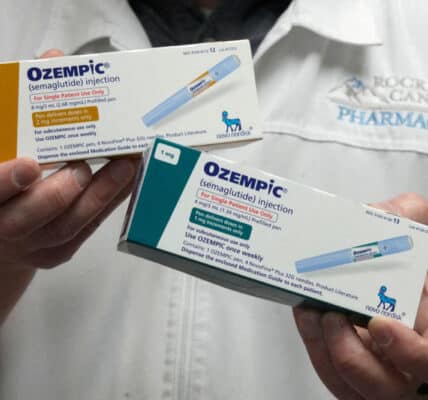
We have been reporting on the side effects caused by the long-term use of GLP-1 drugs such as Ozempic, Wegovy, Mounjaro, and Zepbound. New research has been released showing a connection between GLP-1 drugs and blindness.
On November 9, roughly two weeks ago, the U.S. Food and Drug Administration (FDA) issued new regulations requiring pharmaceutical companies to change their labeling on GLP-1 drugs to warn about this side effect:
The U.S. Food and Drug Administration is informing patients and health care providers of a potential increased risk of non-arteritic anterior ischemic optic neuropathy (NAION) associated with use of glucagon-like peptide-1 receptor agonist (GLP-1 RA) medications. NAION is a rare condition that can result in acute, painless, decreased vision in one eye, including permanent vision loss.
In an opinion piece for The Hill, Dr. Sreedhar Potarazu, a board-certified ophthalmologist, writes that “patients and physicians should not mistake a warning on a drug label for an adequate response to a potentially devastating complication.”
Dr. Potarazu is considered an expert on NAION, having written a landmark paper on the condition a decade before GLP-1 drugs were first approved by the FDA. He describes how NAION manifests:
- NAION can announce itself quite suddenly.
- There may be no pain or warning that anything is wrong.
- A person can wake up one morning and find their vision suddenly impaired.
- There is no established treatment that reliably restores vision completely.
- The consequences can be permanent.
- Many victims are left with lasting visual impairment.
NAION causes sudden, significant impairment. How likely is the risk, considering the current administration of the FDA is not inclined to restrict people’s medical choices? PRAC, the safety committee of the European Medicines Agency, required warning labels on GLP-1 drugs about NAION over a year ago.
The conclusion of the European safety committee regarding how high the risks are of contracting NAION due to the use of GLP-1 drugs is:
After reviewing all available data on NAION with semaglutide, including data from non-clinical studies, clinical trials, post-marketing surveillance and the medical literature, PRAC has concluded that NAION is a very rare side effect of semaglutide (meaning it may affect up to 1 in 10,000 people taking semaglutide).
One in 10,000. Not bad. Except there are an estimated 30 million people in the U.S. currently taking GLP-1 drugs. That means there will be an estimated 3,000 cases of disabling NAION among those currently taking the drugs. Perhaps Dr. Potarazu is right, and a warning label is not enough?
People with diabetes already have an elevated risk for NAION, writes Dr. Potarazu. “Consequently, when someone taking a GLP-1 medication experiences a change in vision, distinguishing between an underlying diabetic complication and a possible medication-associated event is not always straightforward,” he writes.
Dr. Potarazu recommends that patients receive an eye examination before starting on GLP-1 medications, “including an assessment of optic nerve health and a review of existing retinal disease.” He warns:
Anyone taking these medications should know that sudden, painless loss of vision in either eye, new blind spots, missing portions of the visual field, or unexplained visual distortion requires immediate medical attention.
“By the time the patient recognizes the problem, the damage may be irreversible,” Dr. Potarazu writes. He recommends that people taking GLP-1 drugs and experiencing new vision problems immediately get an ophthalmologic evaluation.
The FDA’s latest drug safety communication on GLP-1 drugs recommends that medical professionals “Instruct patients to immediately report sudden onset of acute, painless, decreased vision; visual field deficits; or other visual disturbances in one eye.”
As to what medical professionals should do when a patient who is using GLP-1 drugs is diagnosed with NAION, the FDA offers this surprisingly weak suggestion: “Consider discontinuing the GLP-1 RA in patients who develop NAION, unless the benefits of treatment clearly outweigh the risk.”
They do not call for the discontinuation of GLP-1 drugs upon patients reporting sudden visual impairment. They don’t even call for discontinuation of GLP-1 drug use if the patient is diagnosed with NAION. For the millions of Americans taking GLP-1 drugs, the burden has been placed on you, not your doctors, not the drug companies, to take action to prevent life-altering blindness.
Written by Steve O’Keefe. First published November 24, 2026.
Sources:
“FDA Requires Safety Labeling Changes for Glucagon-Like Peptide-1 Receptor Agonists (GLP-1 RAs) Due to Potential Increased Risk of Rare But Serious Eye Condition,” FDA Drug Safety Communication, November 9, 2026.
“The risk of blindness from GLP-1 drugs is too serious to ignore,” The Hill, November 12, 2026.
“PRAC concludes eye condition NAION is a very rare side effect of semaglutide medicines Ozempic, Rybelsus and Wegovy,” European Medicines Agency, June 6, 2025.
Image Copyright: annastills.