
10% of U.S. Adults Suffer From Work Addiction

In a Zoom presentation on Friday, April 3, students at the University of Southern California’s USC Institute for Addiction Sciences were treated to the release of preliminary data on work addiction by associate professor of psychology at the University of Silesia in Katowice, Poland, Dr. Edyta Charzyńska.
Dr. Charzyńska is one of two project leaders in an international organization called Global Research on Work Addiction. They manage the website, workaddiction.org, and use it to collect and disseminate research on work addiction. Along with her co-leader, Dr. Pawel Atroszko, an associate professor at the Institute of Psychology at the University of Gdańsk in Poland, they coordinate the findings of dozens of experts on work addiction from around the globe.
Their main tool is a giant survey about work addiction that has been gathering data from over 90 countries since 2022. The U.S. version of the study is administered by Indiana University, and anyone may participate through this link. There are three criteria they ask people to observe:
- You must be over the age of 18
- You are currently employed in a workplace with 10 or more individuals and have been for at least one year
- The U.S. survey asks that participants be U.S. citizens residing in the U.S.
It’s not clear why a massive, global study of work addiction would seek to exclude employees at small businesses and self-employed persons from their survey, including gig economy workers. The survey thus involves people mostly working full-time for large, institutional employers.
The goal of the survey is “to understand people’s thoughts, emotions and behaviors connected with their jobs and their impact on the health and functioning of employees.” That’s a much bigger agenda than just work addiction. The survey takes roughly 20 minutes to complete and asks about such feelings as stress at work, job satisfaction, and work-life balance. The survey is anonymous; however, it begins by collecting a significant amount of demographic data on the survey taker.
Some of the findings from the survey reported by the Global Research on Work Addiction include:
- National rates of work addiction range from 6.6% to 20.6%
- The U.S. rate for work addiction is 10.0%
- Work addiction is the most common behavioral disorder
- Work addiction is more common if parents were work addicted
- Work addiction is more common for those who identify as managers
The researchers point to a fascinating study on the prevalence of behavioral disorders and substance use disorders to justify their claim that work addiction is the most common behavioral addiction. Figure 1 shows the estimated prevalence and co-occurrence of 11 different addictive behaviors. Work addiction has a prevalence of 10%, a rate that doubles when combined with any other addiction.
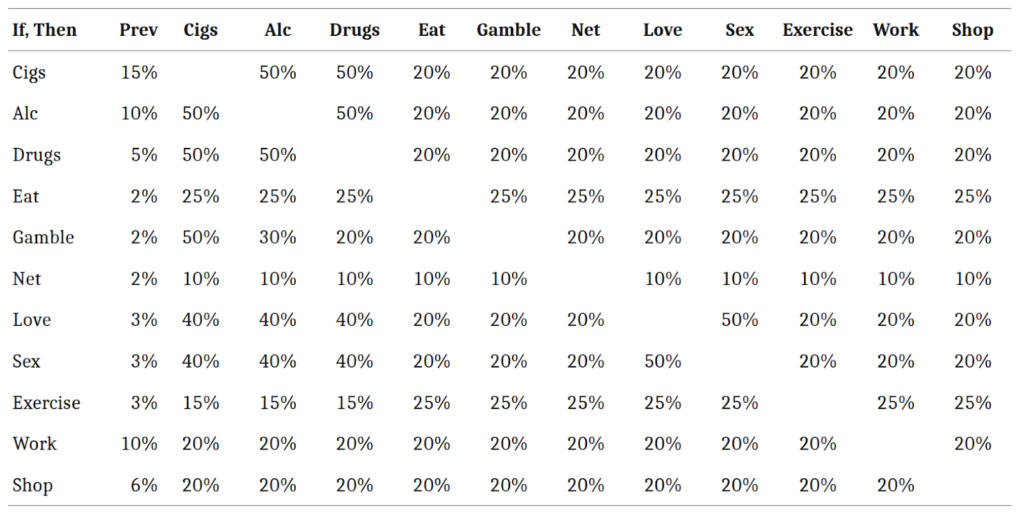
Figure 1: Prevalence and co-occurrence of 11 different addictive behaviors. Source: Evaluation & the Health Professions, used under Fair Use: Commentary.
The research points to stress as the major contributing factor for work addiction. Interestingly, that includes “stress outside the working environment, including related to family problems.” A summary of the research on the organization’s website concludes with this curious assessment, which begs for supporting data:
[I]t seems that countries with established economies and good social care systems have substantially lower rates of work addiction in comparison to post-communist and developing countries.
Few details from the ongoing survey have been released yet. That may indicate a difficulty deriving meaningful data from an anonymous online survey. A major goal of the organization is to develop an International Work Addiction Scale that medical professionals can use to make accurate assessments of patients.
For now, I think the most important revelations of the research are that stress is the major contributing factor in work addiction, and that work addiction is co-occurring with many other behavioral and substance use disorders. I look forward to seeing the data when the full survey is released.
Written by Steve O’Keefe. First published April 14, 2026.
Sources:
“Work Addiction: When Work Stops Working for Us,” USC Institute for Addiction Sciences, April 3, 2026.
“Survey on work-related health and functioning (U.S.),” Indiana University, undated.
“Are you addicted to work? Global survey aims to answer yes or no,” Stuff, November 12, 2022.
“Prevalence of the Addictions: A Problem of the Majority or the Minority?,” Evaluation & the Health Professions, July 12, 2011.
Image Copyright: strelok.