Are Humans and Amoebae Different?
One of the enduring earthly mysteries is, why do people hurt themselves? Admittedly, some reasons make sense if we want them to. In the world of sports, people put themselves through a lot of pain because they know it will build up their muscles and improve their ability to run faster or longer than the next guy, or swim farther, or render an opponent unconscious with a single blow.
Even in the brutal world of cage fighting, there is justification for enduring horrendous injuries. A person wants to take home a belt or a medal or whatever tangible token is offered, to display to the world as proof of superiority. A person wants to win a dazzling prize and be interviewed by Joe Rogan. There is, at least to that individual, and despite the fact that maybe nobody else understands, a quid pro quo relationship. A price is paid in return for something of value.
Many forms of hand-to-hand combat involve a certain amount of protective gear, and even elaborate customized outfits, while others set the opponents against each other wearing skimpy little briefs. Of course, human vs. human contact sports do not hold a monopoly on the opportunity to get hurt. The jockeys who ride race horses suffer their share of pain and damage, and so do marathon runners.
To consciously achieve a state of physical pain, no participation is needed beyond that of the person herself or himself. People put up with that state of affairs in the expectation, or at least the hope, of a reward.
Excellent physical abilities, plus the willingness to undergo pain and even to risk permanent damage or death, make everything worthwhile for the sports star. People take their natural talents, plus the determination to work hard and endure a large amount of pain when necessary, because there is something they want in return. Often, that something is financial compensation, and of course, recognition through publicity generously supplied by media organizations, which have a stake in all this too.
A person will suffer a lot to save “face.” A reputation for being invincibly tough is what some individuals crave above any other reward. Then, of course, there is a medical angle. Someone born with a seriously malformed body might willingly agree to nightmarish surgical procedures. Another willing victim of extensive and painful surgical intervention might be someone suffering from a malady that can be relieved by having half their insides scooped out.
Plastic surgery addresses a body part that has been damaged or even that is merely considered unsatisfactory by its owner. Either scenario involves pain, and the risk of undesirable complications.
But people do it anyway. There is a felt need to fix something that is wrong, or that some people don’t admire (a big nose comes to mind). Or even if no one else in the world can perceive a problem, an individual might seize the notion that something is wrong with her chin, and nothing will convince her otherwise. Last but not least, there is a whole sub-genre of recreational sex that involves pain ranging from merely suggestive to serious torture, which will not be explored here.
Steering back toward the point of all this reflection, a quotation from a scholarly paper will be considered:
Recent literature suggests that both non-suicidal self-injury (NSSI) and suicidal behavior (SB) can also be conceptualized as addictions.
Which only goes to show what a vast territory is covered by the “A” word, addiction.
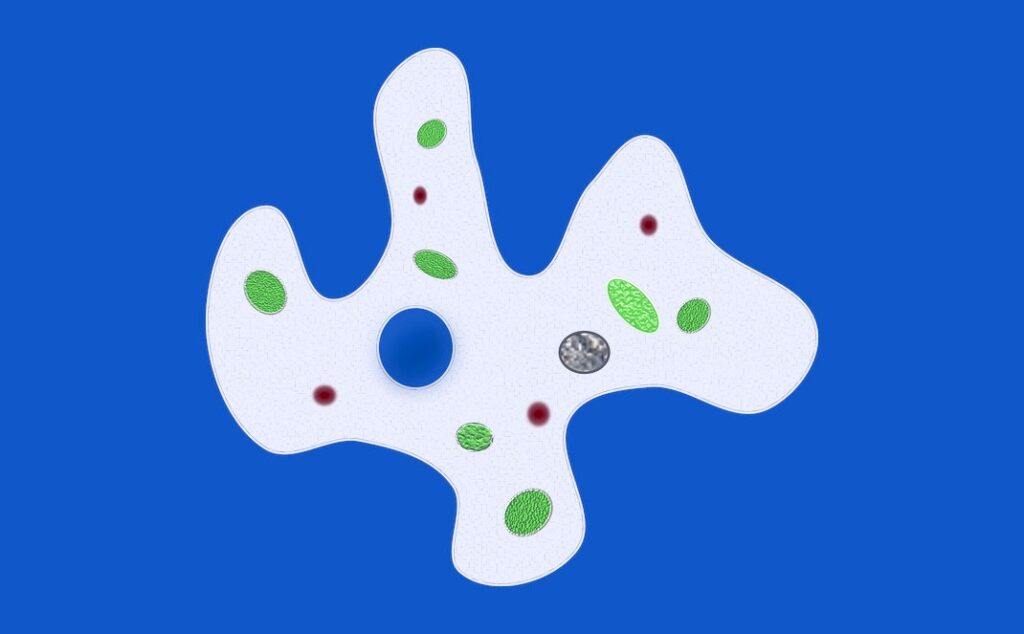
Even an amoeba knows to avoid pain, or at least it appears to move in a way that suggests the intentional avoidance of injury. Why would it even bother to do that, if not for experiencing some negative state (why not call it pain?) that it wished to exchange for a more positive state, such as the absence of pain?
Written by Pat Hartman. First published June 18, 2026.
Sources:
“77 Combat Sports List (sorted by Popularity),” SportsFoundation.org, September 27, 2023.
“The Addictive Model of Self-Harming (Non-suicidal and Suicidal) Behavior,” NIH.gov, February 1, 2016.