
Studies Confirm Early Childhood Screen Time Leads to Mental Health Problems

A new study from the Department of Child and Adolescent Psychiatry and Behavioral Sciences at the Children’s Hospital of Philadelphia concluded that “Smartphone ownership was associated with depression, obesity, and insufficient sleep in early adolescence.”
The study, published in the journal Pediatrics, started with 10,588 12-year-olds who had been diagnosed with depression, obesity, and sleep problems, as identified by the Adolescent Brain Cognitive Development Study, or ABCD Study. Researchers were then able to go back and determine the first date of smartphone ownership for the children, and analyze the correlation between early smartphone ownership and the onset of mental health disorders.
What they found was that owning a smartphone vs. not owning a smartphone was associated with a higher risk of depression and a higher risk of disturbed sleep. The younger the age of smartphone acquisition, the higher the likelihood of obesity in adolescence.
What about those kids who first acquired a smartphone at age 12? By age 13, they “had greater odds of reporting clinical-level psychopathology.”
Not to be outdone, researchers in the U.K. went even further into childhood to study the impact of screen time on language development. They surveyed the primary caregivers of nearly 9,000 infants, once at nine months old and again at two years old. A total of 4,758 surveys were returned, meaning the data is based on a 55% survey return rate.
Here are some of the fascinating statistics coming out of the U.K. survey:
- At nine months old, infants watched screens for an average of 29 minutes a day.
- At two years old, they watched screens for an average of 127 minutes a day.
- 98% of two-year-olds watch television.
- 19% of two-year-olds play video games.
- For two-year-olds who play video games, total screen time increases to 140 minutes per day.
The U.K. researchers found that all this screen time is diminishing children’s vocabularies. Children with the lowest screen time scored significantly higher on vocabulary tests. The children in the highest quintile for screen time were able to speak 53% of the vocabulary test words. Children in the lowest quintile for screen time had an average score of 65%.
Interestingly, the vocabulary scores showing a correlation with screen time are strikingly similar to the scores showing a correlation with family income. Two-year-olds with family income in the top quintile scored 68% on the vocabulary test, while those in the lowest quintile scored 53%.
There are many caveats to the U.K. survey. First and foremost, the amount of screen time is self-reported by caregivers, who tend to underestimate the amount of time their children spend interacting with screens. Second, nearly half the surveys were not returned, and there appears to be no effort made to adjust the statistics for this large non-response. The demographics of the non-responding caregivers could definitely skew the family income numbers, for example.
A study from New Zealand last year found similar negative impacts of early childhood screen time on vocabulary development. The study from the Child Well-being Research Institute at the University of Canterbury in New Zealand analyzed data on 6,281 children at age 2-4.5 years old and again at 4.5-8 years old. Here are some of the findings:
- More than 1.5 hours of daily direct screen time at age 2 was associated with below-average language and educational ability at age 4.5.
- More than 2.5 hours of daily direct screen time was associated with higher-than-average peer relationship problems at age 8.
Figure 1 from the New Zealand survey shows the relationship between screen time at age two and educational ability and peer problems. It’s clear there is a steady relationship between screen time at age two and increasing problems at ages 4.5 and 8.
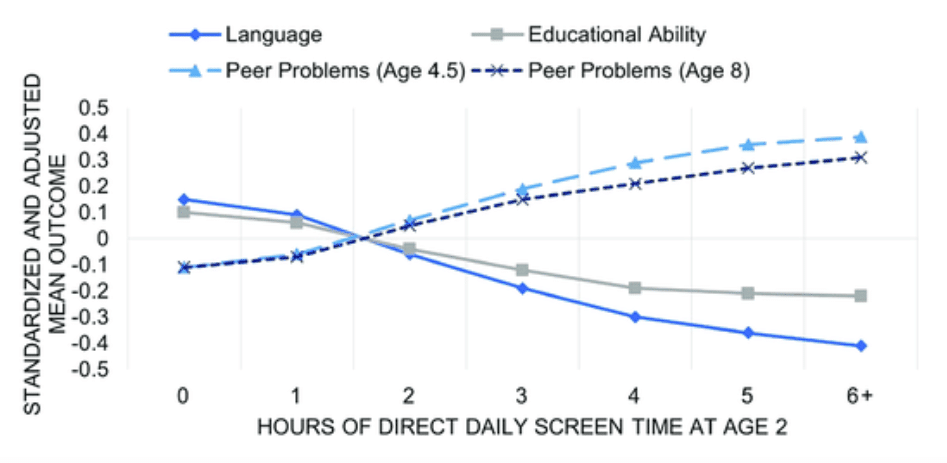
Figure 1: The relationship between screen time at age two and educational ability and peer problems at ages 4.5 and 8. (Source: APA PsychNet, Fair Use: Commentary.)
A more rigorous study into early childhood screen time published last February in Ambulatory Pediatrics did not rely on questionnaires but instead used direct observation to determine the screen-watching habits of 1,200 infants in child care centers. Some of the findings:
- 72% of the children exceeded 2 hours per day of screen time.
- 48% of the children had 3-4 hours per day of screen time.
- A statistically significant decline in IQ scores for children with more than 3 hours a day of screen time.
“The mean IQ score for children with less than 2 hours of screen time was 108, while for children with more than 3 hours, the average score dropped to 95,” the researchers write. Children exposed to high levels of screen time also showed higher levels of hyperactivity, aggression, and social withdrawal.
All the researchers are unanimous in their requests for public health authorities to issue more stringent guidelines concerning early childhood screen time. The World Health Organization (WHO) currently recommends no more than one hour of screen time per day for children aged two to four. The research shows that caregivers are ignoring these guidelines to the detriment of childhood development.
Written by Steve O’Keefe. First published January 14, 2026.
Sources:
“Smartphone Ownership, Age of Smartphone Acquisition, and Health Outcomes in Early Adolescence,” Pediatrics, December 1, 2025.
“Excessive screen time limits vocabulary of toddlers, experts warn,” The Guardian, January 11, 2026.
“Children of the 2020s: home learning environment and screen time at age 2,” U.K. Department of Education, January 2026.
“The Influence of Early Childhood Screen Time on Cognitive Development and Behavioral Outcomes,” Ambulatory Pediatrics, February 9, 2025.
Image Copyright: lakshmiprasad.