
The Addiction to Revenge Offers a Roadmap to Recovery
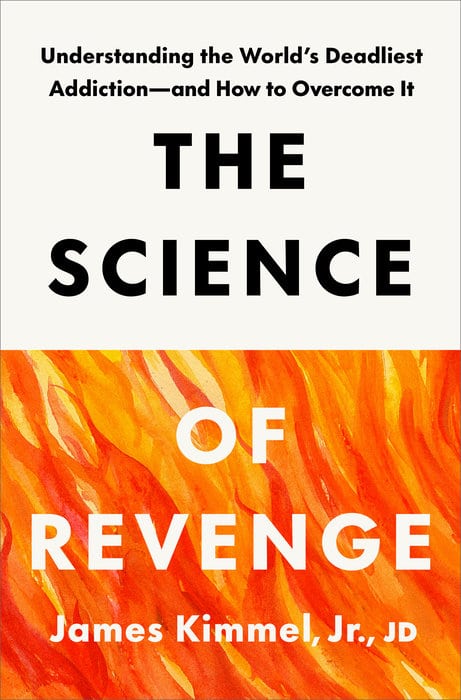
Last year, I wrote a post on AddictionNews that was unique and satisfying. It’s about the addiction to revenge. And it’s based on the pioneering work of James Kimmel, Jr., JD, a Yale professor and author of the book, The Science of Revenge.
Dr. Kimmel, an attorney, is an assistant clinical professor of psychiatry at the Yale School of Medicine. This unique combination of legal expertise and psychiatric science led to his discovery that “compulsive revenge seeking is an addiction.”
Dr. Kimmel is back in the news with an extensive interview on the program No Small Endeavor, a podcast that airs on Nashville Public Radio and focuses on living a good life. In the podcast, Dr. Kimmel shares his origin story, and how the desire for revenge led him to take up the study of the law.
Realizing that the desire for revenge does not disappear with justice but intensifies, he explored the neuroscience of revenge and discovered a familiar pathway of stress, dopamine, displacement, and addiction.
Revenge fantasies are a stress management tool for dealing with psychological pain. Warranted or not, they are collected by individuals, and the revenge scenarios can be run over and over again in the mind, leading to an addiction to revenge.
In the podcast, Dr. Kimmel points out how working as an attorney is a crash course in grievance management:
We lawyers are hired by people with grievances to go out and get even much of the time. Now, not all lawyers and not all the time, but much of the time, especially litigators, that’s what the job really entails, is getting legalized forms of revenge and getting paid to do that.
Then Dr. Kimmel the psychiatrist explains what this does to the brain: “Grievances activate the pain network inside your brain.” He explains that psychological pain, such as shame, grief, and humiliation, manifests as physical pain in the brain.
The revenge fantasy plays out in the brain in a fashion identical to drug addiction. The psychological pain must be displaced, and the revenge fantasy does the trick:
[What we] now know from these brain imaging studies, is that it activates the pleasure and reward circuitry of addiction, the very same area that’s activated for drug addicts and for gambling addicts as well, and for any other kind of addiction that you may have heard of.
Dr. Kimmel makes a strong case for the Unified Theory of Addiction, which says that the origins of addiction come from using any activity or substance to displace stressful energy. The Unified Theory of Addiction states that it’s not the properties of substances that make them addictive, but their use to displace stress and pain.
Similarly, Dr. Kimmel charts a common path from grievance to addiction:
What we’re really talking about is self-medicating to manage pain, right? You get this pain of a grievance. Some people might self-medicate that with narcotics. Some people might with alcohol or tobacco or gambling. Another way that we do it is through revenge seeking.
As we recently reported in a series of articles here at AddictionNews, the attempt to medicate stress is behind most substance use disorders, and not the chemical properties of the substances used. Thanks to Dr. Kimmel’s work, we can see how the addiction to revenge follows the same pattern, sometimes with deadly consequences.
In the solution to revenge addiction, we find a compelling solution to many other addictions: Forgiveness.
Forgiveness, letting go, dropping the issue, even momentarily, provides an instant reduction in tension. At that moment, victims can feel the relief of not caring. “Forgiveness is a wonder drug we’re already hardwired to take, one that stops the pain rather than masking it and asks nothing of the person who wronged you,” says Dr. Kimmel.
Forgiveness is self-activating, self-empowering, usually inexpensive, and quite satisfying. Dr. Kimmel says brain scans show what happens to people when they are cheated, revealing the first inklings of the desire for revenge. “Forgiveness shuts that down,” Dr. Kimmel says, continuing:
I can’t emphasize how important that is. I mean, it stops pain. It does not just cover it up. Revenge-seeking gives you a quick dopamine hit, doesn’t last very long, maybe minutes, then the pain is right back at you. Forgiveness actually stops the pain.
And there you have it: Behind every addiction, behavioral or substance-related, is an attempt to displace the pain of stored grievances. The pain can be beaten back with drugs or gambling or fantasizing revenge, but that relief is only temporary. If the grievance can be dropped, the euphoria of forgiveness can be the most addictive drug of all.
Written by Steve O’Keefe. First published July 21, 2026.
Sources:
“James Kimmel, Jr.: Your Brain on Revenge,” No Small Endeavor with Lee C. Camp, July 6, 2026.
“Unabridged Interview: James Kimmel, Jr.,” Apple Podcasts, July 10, 2026.
Book cover image used under Public Domain: Fair Use.