Thanks for the Miracle
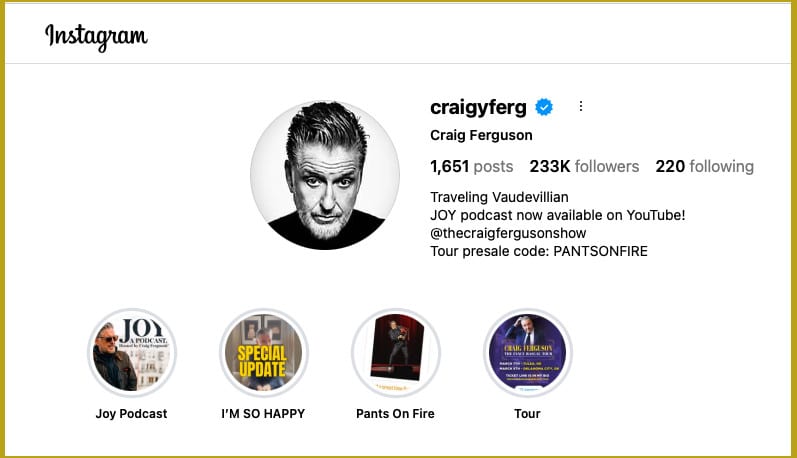
Every show business celeb worth the name has an IMDb page where their professional accomplishments are catalogued. The one belonging to Craig Ferguson, featuring multiple credits as actor, writer, and producer — as well as possessor of miscellaneous other talents — is certainly worthy of pride.
Ferguson, a loved and renowned comedian, is celebrated to an almost equal degree as a recovering alcoholic. Tales of his early, profoundly out-of-control life can be found (among other sources) in The Sunday Times article by Marc Horne.
As a teen familiar with not only liquor, but weed and speed, young Craig somehow managed to avoid shooting up heroin, and only snorted its fumes. But let us not forget about the cocaine, which appeared to be a “wonder drug” because, thanks to its magic powers, he could drink for extended periods and never pass out. Amidst all this loose living, he found time to derive a twisted variety of satisfaction from what reads like some absolute bottom-of-the-barrel experiences with LSD.
But then, he gave up acid and became an alcoholic instead, which did nothing to alleviate the bedwetting that had been a lifelong problem (and which, of course, he later used as comedic material). Somewhere along the way, there was an arrest for attempted auto theft. By Christmas of 1991, Ferguson was hideously in debt and increasingly attracted by the notion of suicide as an exit strategy.
His 2013 comedy special, “I’m Here to Help,” explored the perilous youthful years in detail:
You know when people say, “Oh, yeah, when I was in my late teens and twenties, I experimented with drugs…” No you didn’t. You’re not a scientist. You didn’t experiment with them. Experiment is, you get a white coat, you get the drugs, you feed it to the dog, you film it, you put it on YouTube — that’s an experiment.
So, there was a decade-and-a-half devoted to serious drinking. And the coke and other incidental substances, and the weekend in a Glasgow jail. And the rehab experience, and the subsequent seven years it took to pay off all the debts.
About rehab, incidentally, what that savvy veteran urges that anyone aspiring to recovery should understand is that we’re not talking about a month in rehab. This is some long-term reality. It would be a serious error to think that the future will be a piece of cake. Despite all the humor that such a comedic genius is able to bring to the situation, grim realities are to be faced. You will still be you, which may be a drawback.
“I don’t have a drinking problem. I have a thinking problem.” It’s a Ferguson quotation, and there is no reason to doubt his assessment of the situation. In the recovery process, the alcoholic might be trapped in an old way of thinking while needing urgently to climb on board with a new way of acting. Adaptation will take some time.
Of course, no law says a person can’t have a little fun with it. “In Amsterdam in 1987” seems to be Craig Ferguson’s coded catchphrase to encompass any bizarre or reprehensible scene or activity he might have been involved with, in the bad old days:
I did too many drugs. And when I say I did ’em… I didn’t “experiment” with them.
After 15 years as a blackout drunk, our hero (who, despite all the profound debauchery, remained strikingly handsome) got sober at age 29. To others who wish to do likewise, he recommends hooking up with an organization whose listing is “very near the front of the telephone book.”
We have remarked before on how many professional comedians discovered their talents by addressing their fellow AA members in five-minute increments. This truth seems solidly confirmed by one of Ferguson’s quotations:
The conversation in pubs I thought I’d miss, was more than compensated for by the talk at meetings.
In 2020, the comedian published a book, Riding the Elephant: A Memoir of Altercations, Humiliations, Hallucinations, and Observations. On his 29th sobriety anniversary in 2021, he publicly expressed “heartfelt gratitude to all of you who made this possible.” Gratitude is a term often heard spoken and an emotion often expressed by recovering alcoholics anywhere.
This particular one has also been known to say, “Thanks for the miracle.”
One of his most famous quotations, directed toward anyone still enmeshed in addiction, may not be original, but it is 100% sincere:
You don’t have to wait for it to get worse.
Written by Pat Hartman. First published March 20, 2026.
Sources:
“Craig Ferguson: drink nearly drove me to suicide,” The Sunday Times, September 20, 2009.
“Craig Ferguson: I’m Here to Help,” JustWatch.com, undated.
“Craig Ferguson Talks Sobriety, Alcoholism,” The Fix, May 10, 2019.
Image Copyright: Instagram/Fair Use.