
Multiple Adverse Experiences Lead to Multiple Addictions

Researchers in Italy recently published a study showing “significantly higher levels of addictive behavior” for people who had multiple adverse experiences in childhood. The results, established through network analysis, also found many other interesting associations between adverse experiences and addiction.
Researchers in the Department of Dynamic and Clinical Psychology at Sapienza University in Rome conducted a general survey to find 802 Italian adults to participate in the study. Data was collected from 2021 through 2025. The demographics of the participants have some unusual characteristics:
- 73% were female and only 27% male
- The average age was only 23.6 years
- 55% were single (not engaged), 42% were engaged, and only 3% were married
- 77% were students (not employed), and only 18% were employed
So what, exactly, is considered an “adverse childhood experience”? The researchers used the Childhood Traumatic Events Scale (CTES), a rather lengthy and probing questionnaire that covers “all aspects of trauma” before the age of 17, including death of a family member or close friend, exposure to violence, traumatic sexual experience, extreme illness or injury, and parental separation or divorce.
For each childhood trauma experienced, the CTES asks two questions: 1. How traumatic was this? and 2. How much did you confide in others? These two questions are answered on a 7-point Likert scale from “not at all” to “a great deal.” For the Italian study, however, these two questions were ignored, and all that was tabulated was “yes” or “no” for any one of the six experiences.
Participants were thus divided into those with no reported adverse experiences (192), those with one adverse experience (226), and those with multiple adverse experiences (384). The groups are significantly different. While only 3% of the single experience groups cited a sexual violence incident, and 3% cited a physical violence incident, in the multiple experience group, 25% experienced sexual violence and 22% experienced physical violence. Also, more than 80% of the multiple traumatic experience group were female (310 out of 384).
Researchers assessed addictive behavior using the Screener for Substance and Behavioral Addictions (SSBA), which provides a fairly reliable, quick screening for 10 different addictions:
- alcohol
- tobacco
- cannabis
- cocaine
- shopping
- gaming
- gambling
- eating
- sexual activity
- working
It’s perhaps an interesting commentary on the Italian lifestyle that working addiction and sex addiction make the list, but opioids are nowhere to be found. For each substance or behavior, the SSBA measures on a five-point Likert scale excessive engagement, loss of control, compulsion, and continued engagement despite negative consequences.
This data was then subjected to network analysis, shown in Figure 1 from the study, where group (A) are those reporting no adverse experiences, (B) reporting one adverse childhood experience, and (C) reporting multiple experiences.
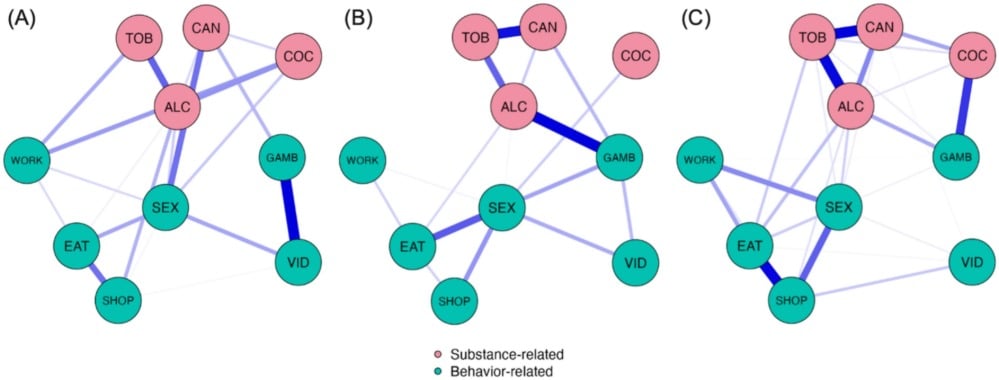
Figure 1: The width of the bonds between any two behaviors indicates the number of times the bond appears among participants in the three groups. Source: Addictive Behaviors, April 2026 (Fair Use: Commentary).
Here’s a rundown on some of the interesting correlations revealed through network analysis of addictive behaviors and adverse childhood experiences:
- Participants with multiple experiences report more severe issues with tobacco use, overeating, and compulsive sexual behavior.
- Addictive behaviors were more closely interrelated for the multiple experiences group, indicating mutual reinforcement and a tendency toward polysubstance abuse.
- Overeating was a significant problem with the one-experience group and an even more severe problem with the multiple experience group.
Researchers say that for people with multiple adverse childhood experiences, eating addiction is associated with shopping addiction, work addiction, and substance use. An analysis of the study in PsyPost suggests that clusters of adverse experiences in childhood bring on clusters of behavioral and substance addictions in adulthood. The lead author of the study told PsyPost that medical professionals should consider treating addiction in clusters, rather than as isolated problems.
The study also reinforces A Unified Theory of Addiction that postulates that all addictions — behavioral and substance — derive from the same source: the need to displace stressful energy. Traumatic childhood experiences lead to stress, and stress seeks an outlet, often several outlets at once. Repeated use of behaviors or substances to moderate stress leads to dependency and sometimes addiction.
The interrelationship between substance abuse and behavioral compulsions illustrated by this study reinforces the need to investigate the crossover between addictions, the need to screen for both psychiatric and substance use disorders, and the need to understand the linkage between traumatic childhood experiences and adult disorders.
Written by Steve O’Keefe. First published March 11, 2026.
Sources:
“The role of cumulative adverse childhood experiences in the interrelationships among addictive behaviors: A network analysis study,” Addictive Behaviors, April 2026.
“Multiple childhood traumas linked to highly interconnected addictive behaviors in adulthood,” PsyPost, March 2, 2026.
“Establishing the relationship between history of childhood trauma and personality disorder using the ICD‐11 classification system,” Personal Mental Health, November 28, 2024.
Image Copyright: kentvs.