Harm Reduction in Charm City
The Atlantic has done a great disservice to readers with an extensive article on harm reduction that implies it has caused a “zombie apocalypse” in “the cities that said yes to drugs.”
Author Michael Powell writes, “Over the past decade, however, overdose death rates climbed sharply in nearly every city where the strongest harm-reduction policies were in place.” That is disingenuous. Overdose death rates climbed just as sharply in cities with zero tolerance policies.
Overdose death rates climbed sharply everywhere due to the surge of fentanyl mixed into the street drug supply, which addicts turned to when the federal government finally put a stop to the over-prescription of OxyContin. Millions of people were legally addicted to opioids, and thousands have died taking illegal fentanyl to ease withdrawal symptoms.
Powell makes the outrageous claim that “the [King] county government paid millions of dollars to supply kits to addicts with tinfoil, pipes, and instructions on how to smoke fentanyl.” First, the kits supplied to addicts contained many things, including the drug naloxone (Narcan) that is credited with saving thousands of lives. The kits also contain test strips, allowing addicts to test for drugs for the presence of fentanyl. And bandages, so they can dress their wounds.
Now let’s look at the science behind shifting addicts from injecting drugs to smoking drugs. It’s literally step one in opioid addiction treatment. Here’s a study from Seattle in an actual scientific journal demonstrating that “many respondents […] reported they reduced their injection frequency because of this access.”
Powell implies that King County encourages drug use when, in fact, they are practicing harm reduction, stepping addicts down from the deadliest drugs and keeping them alive long enough to get into treatment. Do the kits also contain information on who to contact to initiate medicine-assisted treatment? Of course they do.
Powell slips in that the overdose death rate has dropped the past two years, yet does not credit the harm reduction policies that bent the curve, primarily the widespread distribution of naloxone and naloxone training funded by SAMHSA, an agency virtually eliminated by Secretary of Health Robert F. Kennedy, Jr.
Powell complains about the look of “zombies” in public parks, but these are people in pain with nowhere else to go. Do you think they want to be there? They qualify for treatment, but there’s not enough housing for people in addiction treatment. The failure to complete treatment is much higher without housing. Some harm reduction cities, such as Juneau, Alaska, have figured this out.
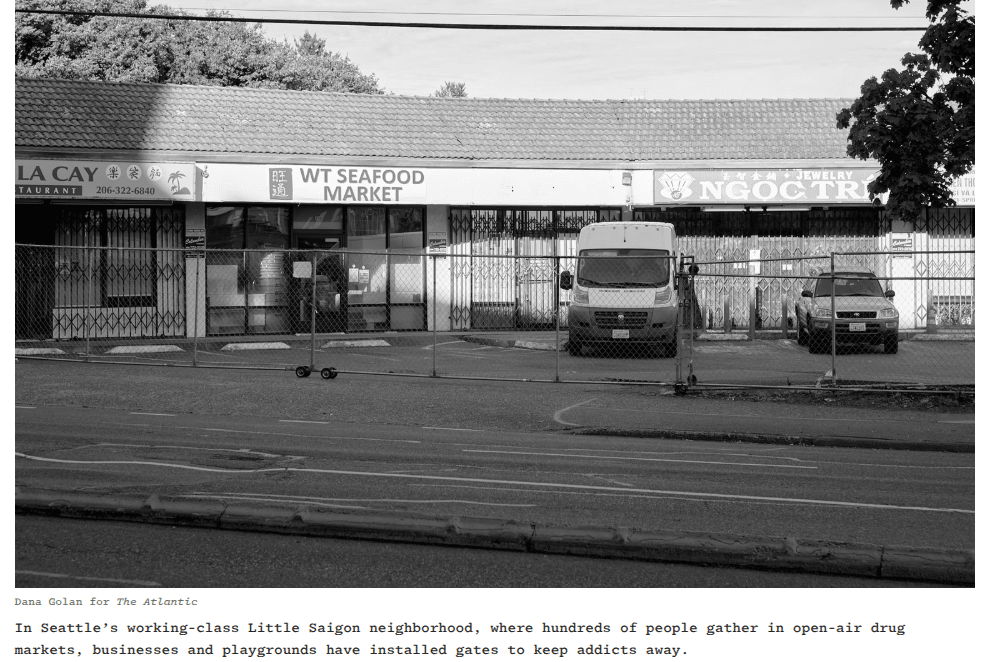
A photograph of an empty parking lot is captioned “hundreds of people gather in open-air drug markets” in The Atlantic. This screen capture contains both the image and the original caption.
Powell claims that the widespread distribution of hydromorphone pills (Dilaudid) “expanded the circle of the addicted and led to more overdoses.” I would love to see some evidence for that claim, since it is fentanyl, and not hydromorphone, that is behind the vast majority of opioid overdose deaths. “Hydromorphone is detected in roughly 3% to 5% of unregulated toxic drug death cases in British Columbia,” according to the coroner.
Powell counts tents in a park in Burlington, Vermont, a sign of homelessness, not drug addiction. He says a man was beaten to death by drug addicts without the slightest effort to ascertain the nature of the dispute. At first, it was believed the assailants were homeless drug addicts, but under further investigation, the altercation was the result of a debt. To be precise, the deceased is said to have stolen $400 from the defendant’s mother and then beat her up when she asked for her money back.
You can blame poverty for that death, and you can even blame the drug culture. But this killing has absolutely nothing to do with harm reduction except that it was exploited by people to get the city to “enhance crime and code enforcement, including against homeless people.” When Powell asks Burlington Mayor Emma Mulvaney-Stanuck what she needs to get the addicts out of the park, she says an injection center, which Powell just spent several paragraphs bashing.
Powell fails to show the cities where harm reduction policies have worked miracles, such as Baltimore, Maryland. Known at one time as the opioid overdose capital of America, Baltimore turned away from the harsh policies of arrest and incarceration for nonviolent drug offenses and instead pursued a policy of tolerance and treatment.
The true face of harm reduction was written up recently by the Center for Mental Health and Addiction Policy at Johns Hopkins University. In 2019, the Charm City Care Connector (CCCC) devoted itself to “reorient its focus entirely around people who use drugs.” In addition to operating a drop-in clinic, the team branched out into case management and the linkage of care for patients.
In addition to the “safe use kits” that Powell mischaracterizes, CCCC offers safe sex kits and wound care kits. They offer showers and laundry facilities, making it easier for clients to prepare for job interviews or get ready for work. The drop-in center offers an abundant supply of clean and new clothing and personal hygiene items. They even offer volunteer crews that clean up the parks Powell is so concerned about.
More importantly, a team from Johns Hopkins and the Baltimore Health Department provides medical exams and onsite treatment twice a week. This gives medical professionals an opportunity to recruit people off the streets and into treatment. Here’s what Johns Hopkins says about the program:
Through the Harm Reduction Specialist program, half of the organization’s employees are former clients, and the program achieved 100 percent staff retention in 2024.
Just in case Powell doesn’t know the numbers for Baltimore, which I’m sure he must be familiar with, since they are among the best in the nation: “Overdose deaths in Maryland have reached a 10-year low after decreasing by 26% in 2025, according to the governor’s office.” This represents a 53% decrease from a high of 2,800 deaths in 2021.
“Data shows that overdose deaths dropped among all drug categories.” So much for the hydromorphone theory. “Fentanyl-related deaths dropped by 31%.”
Overdose deaths are not the only measure, thank goodness. Harm reduction allows “zombies” to feel like people and be treated with respect while they’re trying to put their lives back together. The fact that they have to live in city parks is a housing problem. They would much prefer to complete recovery in a safe shelter.
Written by Steve O’Keefe. First published August 7, 2026.
Sources:
“The Cities That Said Yes To Drugs,” The Atlantic, July 30, 2026.
“High levels of interest in access to free safer smoking equipment to reduce injection frequency among people who inject drugs in Seattle, Washington,” Drug and Alcohol Dependence Reports, May 2, 2023.
“Hydromorphone playing no ‘significant’ role in toxic drug deaths: B.C. coroner,” Global News, June 5, 2023.
“Community Spotlight: Charm City Care Connection,” Johns Hopkins University Center for Mental Health and Addiction Policy, July 30, 2026.
“Overdose deaths reach 10-year low in Maryland after 26% decrease in 2025,” CBS News, January 30, 2026.
Image courtesy of the Charm City Care Connector.