Decoding the Great American Recovery Initiative
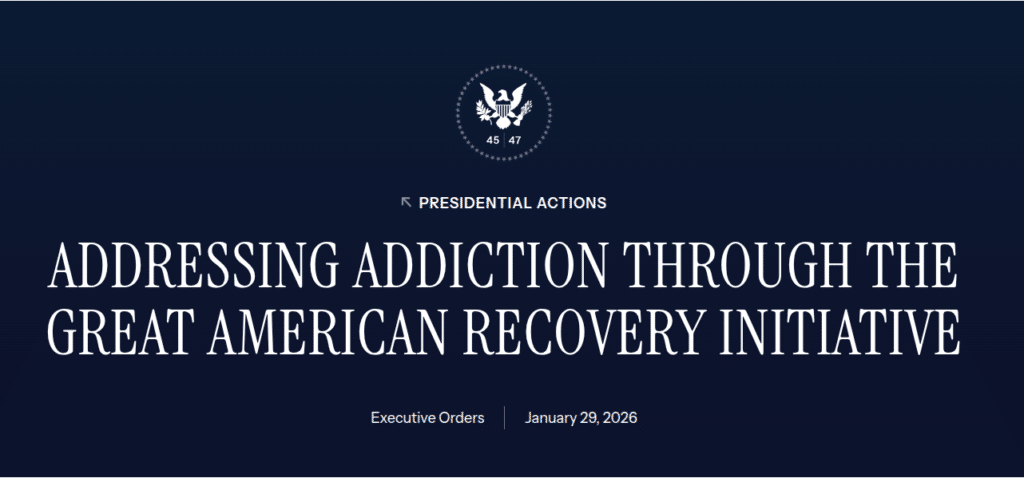
On Thursday, January 29, U.S. President Donald J. Trump signed an executive order creating the Great American Recovery Initiative (GARI), which provides a framework for a plan for combating substance use disorders in America.
It is not clear whether the GARI is an agency, a board, or an entity. It is referred to in the Executive Order only as an “Initiative.” The document contained no evidence of Congressional funding, Congressional approval, or Congressional participation.
The document provides a chain of command for the Initiative: The executive director will report to “the Assistant to the President for Domestic Policy.” It’s not exactly clear who occupies that role at present. Vince Haley is the director of the Domestic Policy Council and an assistant to the president.
GARI is co-chaired by the Secretary of Health and Human Services (HHS) — currently Robert F. Kennedy, Jr. — and the “Senior Advisor for Addiction Recovery.” President Trump simultaneously appointed Kathryn Burgum, the spouse of Interior Secretary Doug Burgum, to the position of Senior Advisor for Addiction Recovery.
Burgum is well-known as an advocate for removing the stigma surrounding addiction. GARI is in fact modeled after a similar initiative in North Dakota called the Office of Recovery Reinvented, chaired by Burgum, which promoted “efforts to eliminate the shame and stigma associated with the disease of addiction.”
Members of the Initiative are designated by job title. They’re all in the executive branch: Attorney General, Secretary of the Interior, Secretary of Education, Secretary of Labor, Secretary of Housing and Urban Development (HUD), and the Secretary of Veterans Affairs. I’m sure these cabinet members welcome having GARI added to their responsibilities.
To be clear, GARI has no official authority, and the Executive Order says so: “Nothing in this order shall be construed to impair or otherwise affect the authority granted by law to an executive department or agency, or the head thereof…”
The obligations of the GARI include:
- “Recommend all necessary steps to coordinate the Federal Government’s response to the addiction crisis.”
- “Take appropriate actions to increase awareness of the disease of addiction, help Americans receive the treatment they need, and foster a culture that celebrates recovery.”
- “Advise heads of executive departments and agencies (agency heads) on how to implement programs that integrate prevention, early intervention, treatment, recovery support, and re-entry.”
- “Advise agency heads on directing appropriate grants to support addiction recovery.”
- Consult with states, local governments, tribes, faith-based organizations, private companies, and nonprofits.
The Executive Order appears to stand this organization up without Congressional review. It says the president is attempting to “remove outdated silos between agencies, programs, or systems,” and integrate housing, healthcare, workforce development, and social services into addiction recovery.
On paper, this sounds great. We have shown repeatedly on AddictionNews how a unified approach to addiction treatment yields results far superior to a focus only on medication and counseling. Often, the launching pad to recovery is housing; free housing during treatment and subsidized housing during job training or job search.
Along with secure housing, people recovering from serious addiction often need medical services, counseling, and assistance re-entering the workforce. Is this what will result from GARI attempts at integration of services? We will know when we see a new focus on providing housing for addiction treatment programs.
The bottom line is there is no bottom line. There is no Congressional appropriation of funds for GARI. The Executive Order states:
This order shall be implemented consistent with applicable law and subject to the availability of appropriations.
The last line of the order says “The costs for publication of this order shall be borne” by HHS. At present, there isn’t enough money to pay for the paper that President Trump signed. There is no clue as to how funds will be shifted to pay for an executive director and staff.
Lev Farcher, addiction reporter for STAT News, said the Initiative “brings bold rhetoric but few details,” and it “appears to duplicate [an] existing White House drug policy office.” It looks like the GARI announcement has garnered as much critical support as another production that premiered the same day: the movie, Melania.
Written by Steve O’Keefe. First published February 2, 2026.
Sources:
“ADDRESSING ADDICTION THROUGH THE GREAT AMERICAN RECOVERY INITIATIVE,” Executive Orders, The White House, January 29, 2026.
“Fact Sheet: President Donald J. Trump Launches the Great American Recovery Initiative to Address the Addiction Crisis,” The White House, January 29, 2026.
“Trump signs order launching new initiative to address drug addiction,” CBS News, January 29, 2026.
“Trump signs executive order to combat substance use,” POLITICOPro, January 29, 2026.
“Sharing addiction story ‘so worth it,’ Kathryn Burgum says,” North Dakota Monitor, October 24, 2024.
“Trump’s addiction initiative brings bold rhetoric but few details,” STAT News, January 29, 2026.
Image Source: Public Domain.