State Governments Partner With Gambling Industry to Fleece Citizens

When the U.S. Supreme Court struck down a nationwide prohibition on sports gambling, it left it up to each state to determine the rules. Spurred on by ready-made legislation provided by the gambling industry, 40 states and the District of Columbia have so far legalized sports gambling.
This tally is constantly maintained by CBS Sports, which breaks down the types of gambling allowed state-by-state. As you learn which states allow for physical casinos, online casinos, physical sportsbooks, and online sportsbooks, you have the opportunity to check the current sporting odds and make wagers, right there at the CBSSports.com website.
We ran an exclusive here at AddictionNews about how Comcast/Infinit replaced all the cable boxes at a senior housing complex with new boxes that enable sports gambling through the TV using the remote control. A quick check of the “Betting” tab at CBS Sports’ website reveals the depth of the problem (Figure 1).
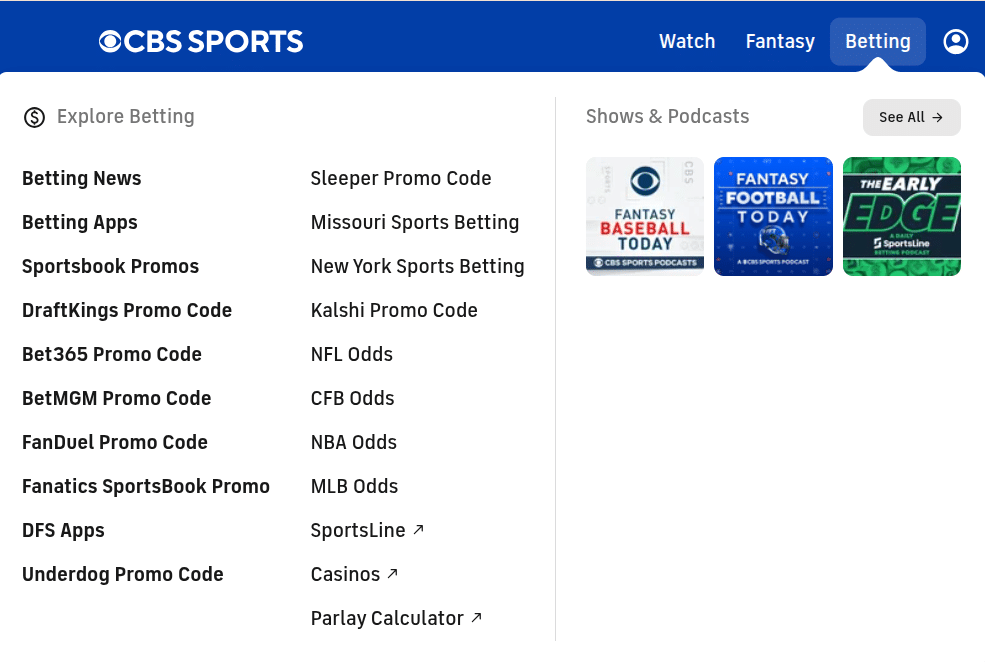
Figure 1: The “Betting” tab at the CBS Sports website offers a mind-boggling variety of options for gamblers.
To summarize the options offered by CBS Sports, there are seven offers for promo codes. Most likely, all of them are limited to new gamblers and require multiple bets. There are links to current odds for four major sports leagues, along with sportslines and casinos. There are advertisements for three sports podcasts and a link to many more.
Along with their stats, CBS Sports serves up some seriously misleading journalism about sports gambling. For example:
State casino tax revenue in states like PA, NJ, MI and WV goes towards programs like education, property tax relief, health services and senior programs.
A review of how states allocate gambling tax revenues found almost no earmarks for education. A few states, such as Michigan and Washington, D.C., earmarked a portion of tax revenues to fund treatment for gambling addiction. Most states put the money into the general fund.
An investigation by Fox5News of the experience of Maryland with legalized gambling yields a different sort of accounting:
- Marylanders lost $2.5 billion in 2025 to legalized gambling.
- The State of Maryland received 1.6 billion of that take.
- The number of Maryland adults with a severe gambling problem went from 1.6% in 2022 to 3.1% in 2024.
- The number of Maryland adults with a moderate gambling problem increased from 4% to 5.7%.
In 2025, Maryland had a population of roughly 5 million people over the age of 18. That means that nearly 300,000 of them reached out to 1-800-GAMBLER or a similar service to get help with a gambling problem. Now guess what percentage of the $1.6 billion the State of Maryland raked in from gambling taxes went to treatment for gambling addiction? If you guessed 1%, you guessed too much!
“The funding totaled $5.7 million in fiscal year 2025,” reports Fox5News. $5.7 million is literally less than a rounding error at 0.4% of the total $1.6 billion taken in by the state. Now, the Maryland legislature is considering expanding legalized gambling, furthering the impoverishment of its own citizens for the financial gain of the gambling industry.
Let’s look at North Carolina, where sports gambling was legalized in 2022, and bets began being placed in 2023. A new documentary from WRAL in Raleigh-Durham found that the state collected $250 million through 2025 and spent — wait for it — $2 million on treatment for gambling addiction. Once again, less than 1% of the windfall.
One thing we’ve learned is not to count on the gambling industry to provide the public with meaningful statistics on problem gambling. The gambling industry has corrupted state governments, bought off the media, co-opted gambling addiction treatment, and is even looking to take over Congress.
For a more sober assessment of what legalized gambling is doing to states, consider the deep-dive analysis of Gabrielle Gurley, senior editor for The American Prospect. Gurley reports on how states are fighting back. Virginia and New Jersey have introduced gambling education into the school curriculum. Maryland and Vermont are considering outright bans. States are also pushing back on the expansion of prediction markets, which allow gambling-like bets on the outcomes of events.
State governments are no match for the deep pockets of DraftKings, FanDuel, Kashi, Polymarket, and the rest of the gambling industry. Gurley reports on federal legislation that the gambling industry is desperate to cut off. We will continue to report on these efforts at AddictionNews.
Written by Steve O’Keefe. First published March 24, 2026.
Sources:
“‘Hidden addiction:’ How much money do Marylanders gamble away?,” Fox5News, March 17, 2026.
“U.S. sports betting: Where all 50 states stand on online sports betting sites,” CBS Sports News, March 2, 2026.
“U.S. online casinos: Here is where all 50 states currently stand on legalizing internet gambling, casino play,” CBS Sports News, March 2, 2026.
“The Scourge of Online Sports Betting,” The American Prospect, February 4, 2026.
“The Early Bets Are In: Is Sports Betting Paying Off?,” National Conference on State Legislatures Briefing, March 01, 2021.
Image Copyright: sinenkiy.